WELCOME

This blog is dedicated to Malta - my island home. My aim is not to bore you with history but to share my thoughts and a few facts together with a photo or two. For a more in -depth background of the island please go here. The purpose of this blog is not to point out the short-comings of the island. There are plenty that do that already. My wish is to show you the beauty of an island at the cross roads of the Mediterranean, a melting pot of history; a place where fact and fiction are sometimes fused to create unique myths and legends; a country that has been conquered so many times that our culture is a mish mesh of the lands that surround us and of lands far away. I confess that my greatest desire is to make you fall in love with this tiny enchanting island.

Pages

Friday, 29 October 2010

Glimpses of Grand Harbour

Valletta (31)  

I may be biased but I think that Malta has one of the most beautiful harbours in the world. I love how its mood seems to change with the different light. This harbour has witnessed many battles and has sheltered hundreds of ships, its turbulent past is now part of history. On the ramparts that surround it, the guns are forever silent and the only sound that breaks the stillness is the gentle sighing of the wind and the mournful wail of some ship’s fog horn as it sails away to a distant shore.


August

Monday, 18 October 2010

A Kitchen Called Victory

Valletta (7)

The recent refurbishing of a shop-front in Valletta led to the discovery of the sign above. Victory Kitchens were opened by the Government at the height of WW2 to alleviate the suffering of the population by distributing free food. In 1942 there was a total of 42 Victory Kitchens in different towns and villages around the island. This particular sign had been painted over and forgotten for many years. It has now been restored and serves as a reminder of those bleak days when the world was at war.

Wednesday, 13 October 2010

The Legend Of The Place They Call ‘Il-Maqluba’

Il-Maqluba (50)

On the outskirts of the village of Qrendi, beneath a chapel dedicated to St  Matthew (more about that in a future post) is a circular depression in the ground. It is known as ‘Il-Maqluba’ which roughly translates to ‘the upside-down one’ or the ‘inside-out one’. This natural depression is said to have been formed in 1343, after a particularly severe winter, possibly accompanied by an earthquake. Il-Maqluba was formed by the collapse of the underlying limestone strata. In geological terms, this is known as a doline. The place is now a sink-hole and collects water from the surrounding fields and country-side. That is the scientific explanation of what happened.

Il-Maqluba (20)

Il-Maqluba (5)  

But there is a more colourful story, of course. It is said that a small village of evil people lived right over the area where the depression is today. A pious lady who lived in the area where the chapel is now situated repeatedly warned her neighbours to change their evil ways – to no avail. As a result, God decreed that the ground beneath the village would collapse, sparing none except the good woman. Angels were then sent to dispose of the hamlet by dumping it at sea. This is said to be how the small island of Filfla, a few miles off the south-west coast of Malta, originated. I suppose that this is a case when the legend is so much more interesting than the truth.

Il-Maqluba (21)

The doline itself is 15 metres deep and has a perimeter of 300 metres. It supports a variety of trees such as bay laurel, sandarac gum, carob and hawthorne and other endemic vegetation. Il-Maqluba (32) 

Equipped with a rope and some sturdy shoes, it is possible to go down into the doline – something which I still need to do. Perhaps this winter I will try to experience Il-Maqluba from the bottom looking up, as opposed to always peering down the steep slopes at its lush green interior.

   Il-Maqluba (48)

For an aerial view of il-Maqluba, go here.

Monday, 4 October 2010

Wayside Chapels (4) – St Mary Magdalen

On a breezy day a couple of weeks ago, we drove to the little town of Dingli and then headed on towards the cliffs which drop vertiginously into the deep blue sea. The summer heat and drought has de-nuded the cliffs and, shorn of the short-rooted plants that grow in the garigue in the cooler months, their jagged edges look sad and forlorn, waiting patiently for the rain that will give them back life.

Dingli Cliffs 015

It is on these cliffs that the chapel dedicated to St Mary Magdalen is situated.

Dingli Cliffs 004

Three steps lead to a small one-roomed building. With the sheer cliffs behind it and the towns of Rabat, Mtarfa and Mdina in the distance, this chapel commands one of the most outstanding views on the Island.

Dingli Cliffs 013

Dingli Cliffs 012

Dingli Cliffs 001

Dingli Cliffs 010


I could not find much information about this chapel other than that it was built in 1640 to tend to the needs of the farmers that made a frugal living from the little terraced fields in pockets of soil on the cliff-face. During the winter months this area is a favoured picnic stop by many but, in summer, it is surrounded by silence and the gentle sighing of the wind.

      Dingli Cliffs 016

Monday, 27 September 2010

The Pink Persian

No matter how many times I’ve wandered though the streets of our capital city, it seems that Valletta never ceases to surprise me. Sometimes I wonder if my eyes have just been opened to the wonder of it all. This pink shop front literally made me stop dead in my tracks. I had passed this way many times before. Was it  really possible that I could have missed such a whimsically painted store all those other times?

Valletta (36)

But now my curiosity is even more piqued. What went on behind that pink facade? Maybe it used to be a restaurant. Or a dance hall. Or possibly a store selling belly-dancing costumes. If only I could find a clue … but this city guards its secrets too well. I will just continue to wonder while looking forward to the next closely guarded secret that Valletta will reveal.

Tuesday, 21 September 2010

Happy Birthday Malta!

Today, September 21, Malta celebrates its  independence. After thousands of years of foreign rule, the island was granted  independence from Great Britain in 1964. For hundreds of years, Malta’s strategic position in the middle of the Mediterranean made it a coveted prize to whatever super-power was dominant at the time. Our shores have seen battles and bloodshed. Our magnificent harbour could tell a thousand tales of the skeletal remnants of ships that lie slumbering beneath its surface.

Valletta at Twilight (5) 

Grand Harbour at twilight

Valletta at Twilight (6)

But the wheel has turned and times have changed. The past belongs to history and what the future holds is still unknown. Hopefully,  these islands will continue to play a part in world history and Malta will continue to celebrate many more birthdays in the future.

flag Photo source

Wednesday, 15 September 2010

Waterspout

September is here and with it come the first storms. There is always a feeling of exhilaration in the air as the hot summer days unwillingly bow out and let the cooler days of autumn take their place. Storms at this time of year can be quite spectacular – with lots of heavy rain, thunder and lightning. Today, the northern part of the island got to witness a natural phenomenon which occurs every now and then – a waterspout.

Photo by Joe Attard

Photo source

Unfortunately, I did not take this picture. I did not even see the waterspout. What am I talking about? We did not even get one drop of rain at my workplace in the southern part of the island. I am quite envious of people who managed to get a photo of it. Oh well … maybe next time.

Some more photos here.

Monday, 6 September 2010

Ruby Tuesday: A Most Unlikely Pear


End August 030

Perhaps you have seen them before. Perhaps you may have even eaten them. But there may be some among you who have never set eyes on these curious fruits. They go by the name of prickly pears. And prickly they certainly are. But pears? That they are not.


End August 033

The prickly pear is the fruit of a cactus known as Opuntia ficus-india which was introduced to the Mediterranean from the Americas. It grows liberally here and even with no care at all, these cacti are usually laden with fruit at this time of year.

End August 032

The fruit comes in three distinct colours: white, yellowish-orange and red. Once the firm, prickly skin is removed, the fleshy fruit can be eaten. Most prickly pears are very sweet and have a very characteristic taste. Here in Malta a liqueur called Bajtra (pronounced Baytra) is made from the fruit.

End August 027

  End August 029   

I thought the red colour of these fruit would make an appropriate entry for this week’s Ruby Tuesday.

RubyTuesdaybadgebydriller[1]

If you are interested in seeing other posts featuring the colour red, please visit  Mary at Work of the Poet.

Wednesday, 1 September 2010

Wayside Chapels (3) – St Agatha’s Chapel

A simple facade – totally unassuming and easily missed amongst the more ostentatious palaces and houses of the old capital.

 Rabat & Mdina (22)

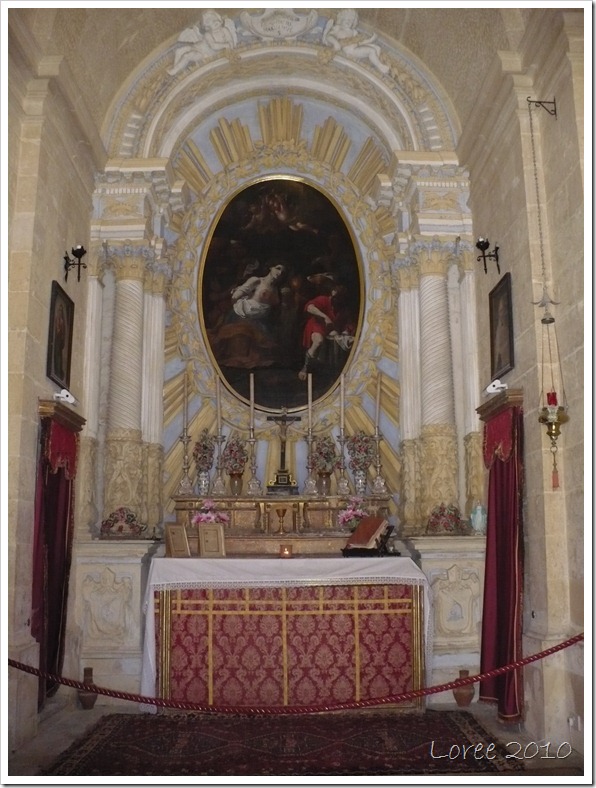
A clean, uncluttered interior; for the most part unadorned – virginal, almost, like the saint it is dedicated to.
 Rabat & Mdina (20)

And as the eyes get used to the dimness they are drawn, by coincidence or by design, to the only source of light pouring down from the sky above.

 Rabat & Mdina (21)

In the silent sanctuary prayers are fervently whispered and comfort is taken in the certain knowledge that they will be heard ….


A chapel to St Agatha was first built on this site in Mdina in 1410 by the nobleman Francesco Gatt and his wife Donna Paola Castelli. The original building was destroyed during a major earthquake that shook the island in 1693. The current chapel, also dedicated to St Agatha, was built in 1694 and was designed by renowned Maltese architect Lorenzo Gafa who was also responsible for the design of the cathedral of Mdina. Grand Master Wignacourt was present for the opening of this chapel in 1696.

Saint Agatha is one of the patron saints of the island together with Saint Paul and Saint Publius. There is a common belief here that Agatha escaped from her native Sicily because she was being persecuted for being a Christian and that she found refuge in Malta for a number of years. When she returned back to her homeland she was martyred by having both her breasts cut off.

When the Turks attacked the island in 1551 it is said that a nun had a vision in which Saint Agatha told her that the people of Mdina needed to take an image of her and all the soldiers and civilians were to carry it in a procession and place it on the bastions facing the enemy. The  Turks are said to have been so impressed by the sheer number of defenders that they left the island and attacked the sister island of Gozo instead – carrying away the majority of the population into slavery. Fact or fiction? What is certainly true is that the Turks did try to attack Malta in 1551 and, for some reason, turned away and attacked Gozo, decimating the population. The rest could be a unique mixture of fact and fiction that is so essential for the birth of legends.

In the past the chapel of St Agatha was only open on February 5th – the feast day of the saint – but in recent years, the chapel has been restored and is now open to the public on a regular basis.

Friday, 20 August 2010

The Fountain of the Washerwomen

On a steep hill leading to Mdina is an old, derelict building. Weeds and small bushes grow out of the cracks and crevices that time and the elements have carved in the stone. The red sign warns people to keep away because of the possibility of collapse; the crumbling stones give an indication of its age. At least four centuries have passed since this building was erected.

Medieval Mdina 008

This is one of a number of wash-houses built by the Knights of St John in areas where natural springs were abundant even  in the hot summer months. It was to these  places that the village women would bring their dirty laundry. Some were servants at the big houses in Mdina, washing the clothes of the nobility for a few pennies. Others would just bring the washing of their whole family.

Medieval Mdina 010

I can only imagine all the tales and gossip that these walls have must have heard as the clothes of the nobleman and the peasant were cleansed in the same spring water. I can almost hear the gay chatter and laughs of the women as they went about their arduous chore. Centuries later the only sound that can be heard is the gentle trickle of the water as it falls into the rough-hewn basins.

 Medieval Mdina 011

Note

Although this building is in imminent danger of collapse, some of these old fountains in other areas have been restored. The foundations of this particular wash-house, however, are built on clay which is why it is in such a bad shape. Hopefully a way of keeping this building intact will be found so that future generations will be able to appreciate our heritage.

The Azure Window: the end of an icon

The Azure Window was a natural limestone arch that rose majestically out of the blue Mediterranean sea to a height of 28 metres (92 fee...