WELCOME

This blog is dedicated to Malta - my island home. My aim is not to bore you with history but to share my thoughts and a few facts together with a photo or two. For a more in -depth background of the island please go here. The purpose of this blog is not to point out the short-comings of the island. There are plenty that do that already. My wish is to show you the beauty of an island at the cross roads of the Mediterranean, a melting pot of history; a place where fact and fiction are sometimes fused to create unique myths and legends; a country that has been conquered so many times that our culture is a mish mesh of the lands that surround us and of lands far away. I confess that my greatest desire is to make you fall in love with this tiny enchanting island.

Pages

Showing posts with label tombs. Show all posts

Sunday, 24 February 2013

The Tombs of Our Fathers

Chicken pox 032

You may all be wondering why I am sharing a photo of what seems to be a square cut out into the rocks. For many years these ‘formations’ puzzled me. When left to its own devices,  it is very rare for nature to form squares. But finally the mystery, such as it was, was solved. A few years ago I met a lady who explained who had made these squares. What we are seeing today is actually the top of a shaft that was cut into the rock. The shaft descends vertically to a tomb that is dug at right angles to the shaft and straight into the rock. From artifacts found inside the tombs it was concluded that they date back to Punic times. Appropriately, the tombs  face the setting sun. It all seems so obvious now that I wonder how I never figured it out for myself.

Punic Tomb,  Mtarfa

Thursday, 17 November 2011

St Paul’s Catacombs–An Underground Necropolis

I recently re-visited the catacombs of St Paul. The last time I was in this underground necropolis I was just a child. Visiting the place as an adult felt vastly different. The tombs are empty but I could not help thinking about the lives of the people who had lain here. It’s easy to become morbid in a place like this so let’s move on to the historical facts.

Rabat and the Catacombs (15)

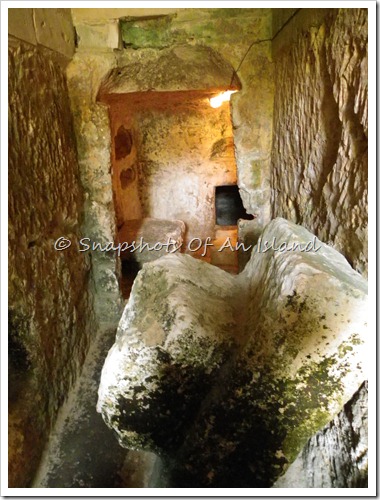
The catacombs of St Paul are situated in the town of Rabat. In the past, when Melite (modern day Mdina) was much larger, this area would have been just outside the gates of the city. The catacombs in  Malta were used solely for burial purposes since there is no record of any type of religious persecution during this era. These catacombs were the last resting place of Christians, pagans and Jews. St Paul’s catacombs were used up to the 4th century AD. The complex covers an area of 2000 square metres. One enters the catacombs by going down a flight of steep steps which lead into a main hall. This hall was used for the various activities associated with funerary rites.Two reclining tables, known as agape tables, were probably used for commemorative meals. 

Rabat and the Catacombs (3)

It is thought that in the 13th century this hall may have served as a shrine during the re-Christianising of the island. Doorways in the main hall lead to various passages, carved out from the limestone, which are lined with a numerous array of tombs.

Rabat and the Catacombs (24)

Rabat and the Catacombs (27)

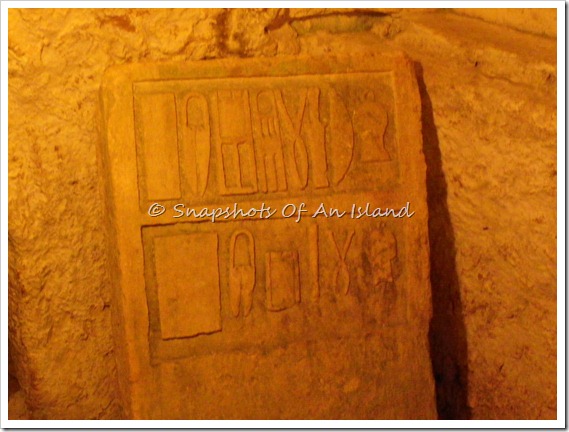
Some of the tombs were closed up with blocking stones, some of which had carvings on them. This one is decorated with surgical tools of the time which suggests that it is the burial place of a surgeon and his family or, possibly, a group of surgeons.
Rabat and the Catacombs (8)

Rabat and the Catacombs (9)

Rabat and the Catacombs (10)

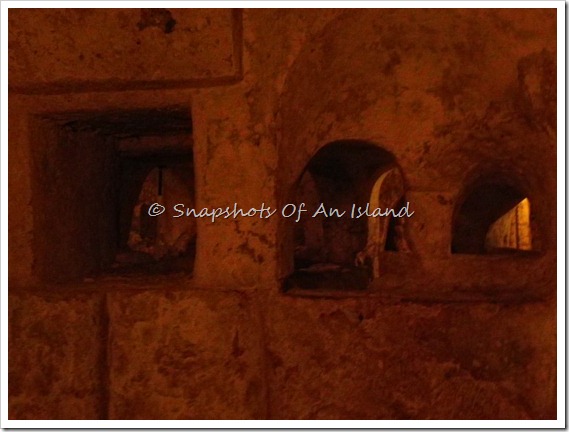
Perhaps the most disturbing aspect of these catacombs is the large number of tombs known as ‘luculus tombs’. These small tombs were the final resting place of children and babies and the large number that can be seen hewn in the rock is a poignant reminder of the high infant mortality rate that existed at the time.

Rabat and the Catacombs (19)

In the past these catacombs were lit by oil lamps that were placed in small nooks in the passage-way walls. Vents in the ceiling provided fresh air and some light during the daylight.

Rabat and the Catacombs (29)

At present, St Paul’s catacombs are being monitored for temperature and humidity levels. It is expected that full restoration of the catacombs will be complete by 2013.
Rabat and the Catacombs (16)

The catacombs of St Paul are on UNESCO’s tentative World Heritage List. It is, indeed, important that sites such as this are studied and maintained for future generations. They not only provide us with a glimpse of the past but, on a human level, a link to our ancestors.

This link from Heritage Malta should enable you to see the catacombs in 360.

Rabat and the Catacombs (23)Rabat and the Catacombs (25)


St Paul’s Catacombs

St Agatha Street

Rabat

October 2011

Thursday, 20 October 2011

Wayside Chapels – Our Lady Of Itria

Bingemma, Gnejna & Dwejra (35)

This chapel is situated in the picturesque location of Bingemma (pron. Binjemma) right at the edge of a rock-face overlooking a valley. The first chapel in this area was built in 1600 by the Noble Giovanni Maria Xara. By 1658 the chapel was pretty much in ruins but in 1680 Baron Stanislaw Xara demolished the church and had it rebuilt, using the same stones, in its current location.

Bingemma, Gnejna & Dwejra (2)

Like the majority of wayside chapels, the façade of this chapel is very simple – the only decoration is the coat of arms of Baron Stanislaw Xara above the circular window together with a small belfry with a cross on top.

Bingemma, Gnejna & Dwejra (4)

Bingemma, Gnejna & Dwejra (30)

A number of caves in the limestone rock-face were used as dwellings during the Bronza Age period. Also in this area are a small number of Punic tombs and shards of Roman  pottery have also been unearthed by farmers working in their fields in Bingemma valley. Not far from this chapel the British had built a fort (Fort Bingemma) together with a line of fortifications known as the Victoria Lines. These defenses stretch for 12km from Madliena in the east to Bingemma in the west.

Bingemma, Gnejna & Dwejra (11)

Bingemma, Gnejna & Dwejra (14)

The view from the back of the chapel is quite magnificent with terraced fields, rolling hills and the sea stretching out as far as the eye can see.

Bingemma, Gnejna & Dwejra (29)

Bingemma, Gnejna & Dwejra (5)

Bingemma, Gnejna & Dwejra (19)

Bingemma, Gnejna & Dwejra (8)

In the distance, the island of Gozo is clearly visible.

Bingemma, Gnejna & Dwejra (9)

Bingemma is a wonderful place for a family outing and there are many paths in the area along which one can take a peaceful walk disturbed only by the drone of bees and chirping  birds.

Note

The title ‘of itria’ is an abbreviation of the Greek word ‘hodigitria’ – she who shows the way. The word ‘itria’ was corrupted by the Maltese to ‘ittra’ which is the Maltese word for letter. Thus, sometimes, this chapel is mistakenly referred to as Our Lady of the Letter.

The Chapel of Our Lady  of Itria is open every Sunday at 7.00am and during the last weekend of October when the feast is celebrated.

Photographed at

Bingemma

March 2011

The Azure Window: the end of an icon

The Azure Window was a natural limestone arch that rose majestically out of the blue Mediterranean sea to a height of 28 metres (92 fee...