WELCOME

This blog is dedicated to Malta - my island home. My aim is not to bore you with history but to share my thoughts and a few facts together with a photo or two. For a more in -depth background of the island please go here. The purpose of this blog is not to point out the short-comings of the island. There are plenty that do that already. My wish is to show you the beauty of an island at the cross roads of the Mediterranean, a melting pot of history; a place where fact and fiction are sometimes fused to create unique myths and legends; a country that has been conquered so many times that our culture is a mish mesh of the lands that surround us and of lands far away. I confess that my greatest desire is to make you fall in love with this tiny enchanting island.

Pages

Wednesday, 29 August 2012

Wayside Chapels – St Anthony (l/o Mdina)

Winter countryside (1)

This chapel is situated in an abandoned cemetery underneath the lofty walls of Mdina. The cemetery was used to bury people who died during outbreaks of the plague or who fell victim to other infectious illnesses such as cholera and tuberculosis. Up until fairly recently, both the chapel and the cemetery were derelict and over-grown with weeds and wild plants. In the last couple of years some form of restoration effort seems to be taking place. According to the website Kappelli Maltin (Maltese Chapels), the chapel was built some time in the mid-1800s.

Winter countryside (3)

St Anthony’s Chapel & Cemetery

Infetti Road

l/o Mdina

Photographed February 2010

Tuesday, 31 July 2012

St Paul’s Cathedral, Mdina

Dwejra, Nadur &  Mdina (61)

There is a 2000 year old tradition, passed down through countless generations, that the apostle Paul met the Roman governor Publius on this site, where the cathedral dedicated to him stands today. Publius converted to Christianity and became the first bishop of Malta. This is not the first cathedral to grace this spot. The first cathedral, which is said to have been dedicated to the Blessed Virgin fell into disrepair during the Muslim period. This was followed by a Norman church in Gothic style, re-dedicated to St Paul, which was enlarged and modified several times. This building was destroyed by the earthquake of 1693 and the current edifice was erected in its place.

Dwejra, Nadur &  Mdina (40)

Dwejra, Nadur &  Mdina (42)

This Baroque structure was designed by Maltese architect Lorenzo Gafa and was built between 1697 and 1702. Gafa’s magnificent dome is considered to be one of the most beautiful in Malta. The interior of the cathedral is lavishly decorated with paintings, stained glass windows, inlaid marble tombstones, silver candelabra and gold leaf. One of the most famous paintings is Mattia Preti’s Conversion Of St Paul which used to hang in the old cathedral but somehow managed to survive the earthquake. Go here for a 360 view of the interior.

Dwejra, Nadur &  Mdina (43)

Dwejra, Nadur &  Mdina (44)

Dwejra, Nadur &  Mdina (45)

Dwejra, Nadur &  Mdina (46)

The Mdina sky-line (which you may see in my header  photo), with the cathedral perched on the edge  of the hill, is one of the most recognised views in Malta and can be seen from many places around the island, both during the day and at night - when it is lit up. The façade of the cathedral is divided into three bays with two bell towers at the corners.

Medieval Mdina 077

Beneath each bell tower is a clock. According to legend, the clock on the left was purposefully placed there to confuse the devil since it does not appear to tell the correct time. In reality it shows the date and month of the year. The clock on the right is the time-keeper and it strikes every 15 minutes.

Medieval Mdina 078


Dwejra, Nadur &  Mdina (49)

Dwejra, Nadur &  Mdina (50)

Dwejra, Nadur &  Mdina (51)

Dwejra, Nadur &  Mdina (52)

Dwejra, Nadur &  Mdina (54)

As a child I would often stand at the cathedral’s main door and look up into the sky. They scurrying clouds made it seem as if the spires were moving and dancing to some secret rhythm. At the time, this was one of the highest buildings that I had seen. These days, I am no longer awed by its height but I still like to stand at its base and gaze upwards towards the heavens. And still the spires seem to dance. And I smile, because for a brief instant I am child again.

Dwejra, Nadur &  Mdina (55)

Metropolitan Cathedral of St Paul

St Paul’s Square

Mdina

Tuesday, 24 July 2012

Malta And The Movies (2): Clash Of The Titans (1981 version)

It’s hard to believe that so many years have passed since this movie first came out and that it has now been re-released. Prior to the advent of computer generated animation, a special effects technique known as stop motion animation was used to create the mythological creatures in the movie. Clash Of The Titans is an adaptation of the Greek myth of Perseus and his quest to destroy both the Gorgon, Medusa, and the Kraken sea monster to save princess Andromeda. The storyline in the movie is rather different from the original myth – but then, movies usually are. Laurence Olivier as Zeus, Ursula Andress as Aphrodite, Harry Hamlin as Perseus and Claire Bloom as Hera were amongst the stellar cast.

Although many people are familiar with the original movie and have probably seen it, not many people know that a portion of the movie was filmed on the island of Gozo (one of the three major islands that make up the Maltese archipelago). The scene below, with the Kraken rising out of the sea, was filmed at the Azure Window, one of the most recognisable landmarks in Gozo. The clip is a bit long but you can see the Azure Window at 1:19.


Sunday, 15 July 2012

The Southern Coastline: Hofriet

Delimara (33)

Hofriet is the Maltese word for holes and it aptly describes this cove, and another next to it, situated in the southern part of the island, because when seen from above, they do look like two adjacent holes separated by a thin strip of land. This part of Malta is characterised by soft, white, limestone  cliffs. In some places, the slopes incline gradually towards the sea. In others, the drop is sheer and unforgiving.

Delimara (34)

The best way to reach this cove is either by boat or else by swimming from the next bay through an archway in the cliff.

Delimara (35)

A precarious path down to the water  probably also exists – although I could not see one.

The scenery is quite pretty - the blue sea in sharp contrast with the bleached limestone of the rocks and cliffs.

Steven and Cristina 050

You will notice a difference in the colours of the photos since they were taken on two very different days: a breezy day in early June and a bright summer’s day in mid-September.

Steven and Cristina 051

That is one thing that I absolutely love about the sea – it’s ever-changing faces and moods.

Steven and Cristina 052Steven and Cristina 053

I have yet to visit Hofriet during the winter when the wind will roar and heave the sea into columns of spray. It must surely be a spectacular sight.

Photographed at

Hofriet

Delimara

June and September 2011

Thursday, 28 June 2012

Introducing … Bormla

Bormla 007

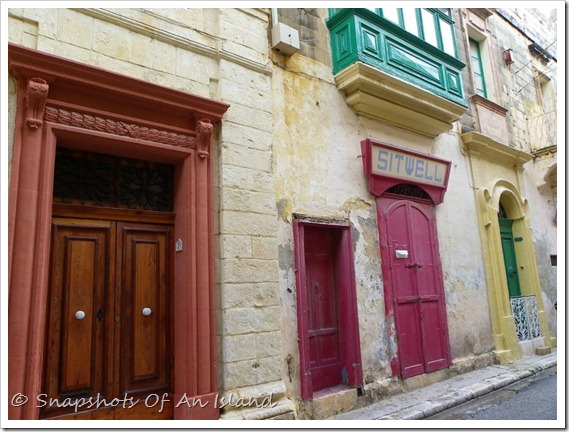
On a rainy day, last February, we went for a walk in Bormla (also known as Cospicua) – one of the Three Cities. This town in Grand Harbour, hemmed in between Birgu and Isla, its more well-known neighbours, has had a colourful and often-tragic history.

Bormla 009

Although it has been inhabited since pre-historic times, it also bore the brunt of Malta’s two major sieges. In 1565 it was decimated by the Turks. It was subsequently fortified by the Knights of the Order of St John and started to thrive when the Order used its creek as a berthing place to anchor and repair their ships. During the British years, the Royal Navy built their dockyard in the same spot. This created hundreds of jobs in the area and ushered in Bormla’s golden years.

Bormla 013

Due to its proximity to the dockyard, Bormla was heavily bombarded by Axis airplanes during WW2 and many historic buildings were severely damaged or totally destroyed. The majority of the population took refuge in the countryside. After the war, the town rose again from the debris and the ashes but, in many cases, planning was erratic and many of the new buildings did not fit in well with the pre-war architecture that managed to survived.

These days Bormla looks a bit faded, a bit tired, as if it is still dreaming of its glory days. It needs a facelift, one that is not just cosmetic. It needs life to be injected back into it. Perhaps it needs to recapture the pride of its golden years and wipe out all the bad memories.

Bormla 016

This harbour town is not what I would call pretty – at least not right now. It has some scars. And they run deep. There are definitely some social problems in the area and most of the population tends to focus on these negative points. I admit that this is not a place where I venture often. Indeed this is probably my first walk around this town since I was a young child. But I think that that is about to change.

Bormla 010

It is high time that I explore this place a bit better, get to know it a bit more. Hopefully more of its buildings will be restored and renovated so that it will regain its former lustre. For the sake of our heritage I trust that this will happen sooner rather than later – before it is too late.Bormla 006Bormla 012Bormla 014

Photographed in the streets of Bormla

February 2012

Wednesday, 20 June 2012

The Kitchen Garden

The Kitchen Garden is situated opposite the back entrance of San Anton Palace. It has been supplying vegetables to the Palace since the 17th century, when the palace was built as a summer residence by  Grand Master de Paule.

Kitchen Garden 002

The garden was extensively rehabilitated and was opened to the public last year. It is built on three levels: the children’s play area, cafeteria and animal pens are on the lowest level; a rose and herb garden is on the next  level and the last is the Swan Terrace. This terrace is built over a larger reservoir built in 1766 to provide water for the garden.

Kitchen Garden 014

Kitchen Garden 009

Kitchen Garden 003

Kitchen Garden 004


Kitchen Garden 010Kitchen Garden 011Kitchen Garden 012

The Kitchen Garden still serves its original purpose of supplying the Palace with fruit and vegetables.

Kitchen Garden 020Kitchen Garden 044

The Kitchen Garden

San Anton Street

Attard

Photographed July 2011

Opening hours:    Winter: Monday to Friday — 9:30 am to 2:00 pm
Summer: Monday to Friday —10:00am to 10:00pm
Saturday, Sunday, Public Holidays — 9:00 am to 1:30 pm

Kitchen Garden 042

Thursday, 14 June 2012

The Banca Giuratale

Medieval Mdina (1)

The Banca Giuratale (or Municipal Palace) is a Baroque building in Mdina’s main street. This building was designed by de Mondion and built in 1726 by Grand Master de Vilhena to house the offices of the civil administration of the island. The façade is quite imposing and heavily decorated, as was common during this period.

Medieval Mdina (2)

Medieval Mdina (3)


The civil administration held the district court in this building until 1831 after which it was leased to private individuals. It was taken over by the Education department in 1881 and was used as a secondary school until 1969. It was then leased to the Sisters of St Dorothy for a short period of time and functioned as a private school. Today, the Banca Giuratale houses part of the national archives, specifically court proceedings from 1530 to 1900. An exhibition of portraits of Maltese personalities is on permanent display in the hallways of this palace.

I have my own special ties with this building since I went to school there for 3 short years in the mid-1970s.

Medieval Mdina (4)

Main Staircase

Medieval Mdina 107

Banca Giuratale – Facade


Banca Giuratale

Villegaignon Street

Mdina

Opening hours:

Monday 8.00a.m. – 2.00p.m. / 3.00p.m. – 7.30p.m.

Tuesday/Wednesday/Friday 8.00a.m. – 2.00p.m.

Thursday 10.00a.m. – 2.00p.m.

Wednesday, 30 May 2012

The Best Places To Enjoy Sunsets

It’s almost June and summer is practically at our doorstep. Warm weather and mostly-cloudless skies are synonymous with Mediterranean summers  - perfect conditions for spectacular and fiery sunsets.The western coastline of Malta is, for obvious reasons, a great place to choose to watch the setting sun (if you’re into that sort of thing, of course). What makes this coastline even more suited to this particular activity, apart from its location, is the un-spoilt, natural beauty of this part of the island. Towering cliffs, plunging valleys, tiny coves, sandy beaches and all sorts of caves and inlets provide a quiet (depending on the season) and often romantic spot from where to watch one of Nature’s daily shows that we so often take for granted. The following is a list of my 3 favourite spots:

Dingli Cliffs

These mighty cliffs plunge 250 metres into the watery depths and are the perfect perch from where to watch sunsets. Weekend nights may be a bit crowded but during the week they are a haven for all those seeking a peaceful spot.

Dingli Cliffs at Sunset (33)

Ghar Lapsi (Lapsi’s Cave)

This little cove on the outskirts of the town of Siggiewi is a popular bathing spot with those that like rocky beaches. The best place to watch the sunset is not down in the cove itself but from the rocks that tower above.

Ghar Lapsi 007

Gnejna Bay (pronounced Jineyna)

Deserted in winter, this small bay is usually quite crowded during the summer months but, by sunset, most of the people will have already left, leaving a few stragglers, like myself, who prefer the beach at this time of day. As the sun gets lower in the sky, it moves to the left side of the bay and sets behind the rocks. The burn-off from the sun and the jagged silhouette of the rocks creates a wonderful play of shadow and light that I never get bored of looking at.

Gnejna Again (19)

The Azure Window: the end of an icon

The Azure Window was a natural limestone arch that rose majestically out of the blue Mediterranean sea to a height of 28 metres (92 fee...